Gong × Allvue Systems
Gong x Allvue, sales cycles cut 14% and close rates up 44% with AI-powered discovery standards
44% increase in qualified close rates
Subjective guesswork to measurable operating rhythm
Members read free
Unlock the full breakdown
Enter your email to open every case study in the library: the full screenshot, why it works, and the one thing worth stealing. One email unlocks all of them.
Free. No spam. Unsubscribe anytime.
You're in — enjoy the library.
Why it works
The story earns its headline numbers by explaining the specific mechanism behind them: a three-pillar discovery rubric enforced through AI Tracker and Scorecards, with win/loss analysis revealing that cost-of-inaction talk appeared 288% more often in won deals. The coaching volume stat (23 scorecards to 218 in one quarter) is a strong secondary proof point that shows adoption depth, not just outcome claims. This is a genuine coin-flip between Breakthrough and Efficiency since both a number going up (close rates) and a number going down (cycle time) lead the headline, but the qualified close rate improvement anchors the narrative more firmly as the business-growth win.
Steal this
The win/loss analysis anchor: surfacing that a specific behavior (cost-of-inaction discussion) appeared 288% more in won deals gives readers a concrete, replicable diagnostic move rather than a generic 'use AI to coach better' message.
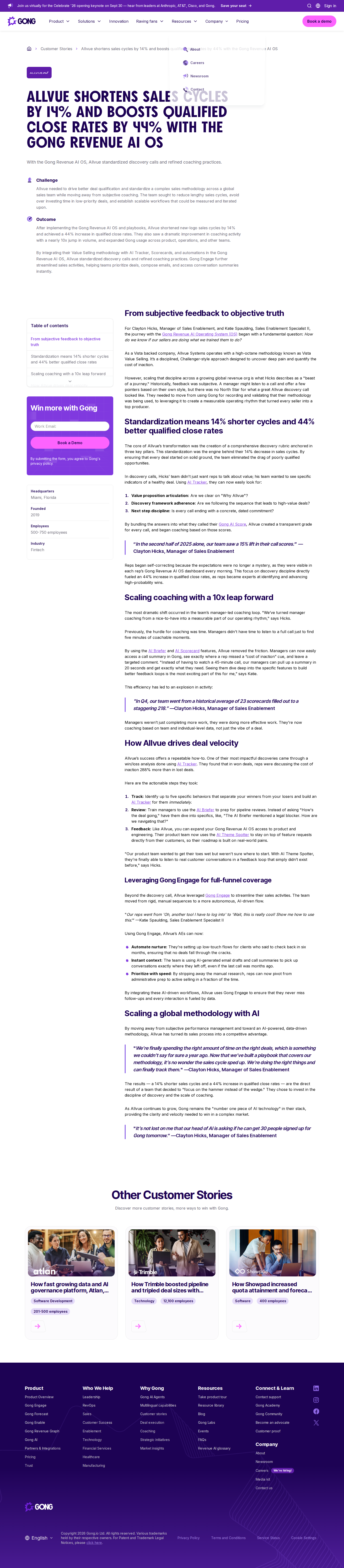 Click to enlarge ↗
 This is editorial commentary and curation. The case study, screenshot, and all metrics are Gong's published work; we link to the source and lead with our analysis.