Harness × Ancestry
Harness x Ancestry: From 80 Jenkins instances to 50% fewer outages
50% reduction in deployment-caused production outages
Ungoverned chaos to centralized pipeline control
Members read free
Unlock the full breakdown
Enter your email to open every case study in the library: the full screenshot, why it works, and the one thing worth stealing. One email unlocks all of them.
Free. No spam. Unsubscribe anytime.
You're in — enjoy the library.
Why it works
The case study grounds every claim in a specific before-state: 80-100 disconnected Jenkins instances with no governance, a concrete number that makes the problem vivid. The 50% outage reduction and 78% onboarding effort reduction are tied directly to the deployment unification mechanism, so the logic holds. This sits between Efficiency and Resilience since the headline leads with effort reduction but the executive driver was uptime, and the analysis notes both without forcing a clean separation.
Steal this
Anchor the before-state in a specific count of broken things (80-100 Jenkins instances) rather than a vague description of messiness. A raw number makes the chaos legible and gives the reader an instant scale reference.
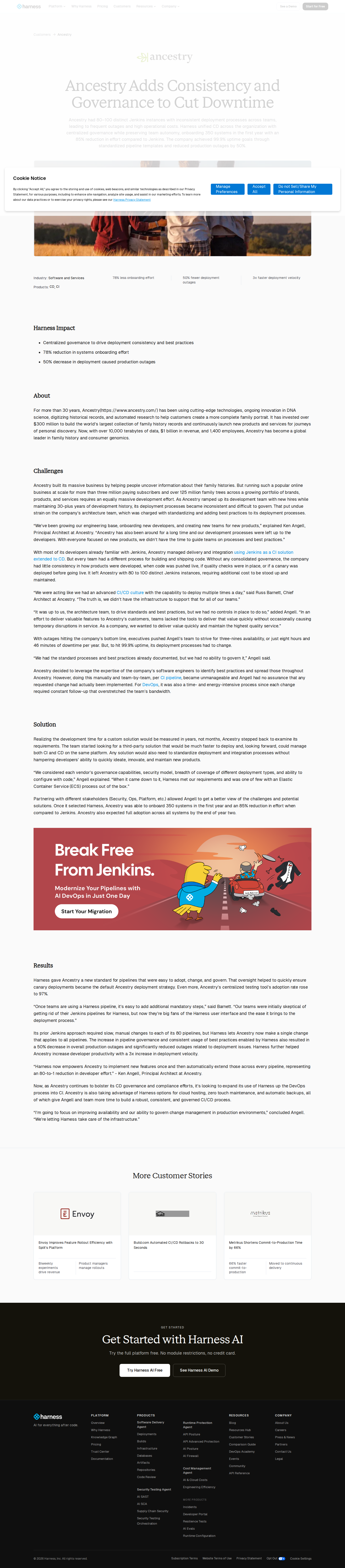 Click to enlarge ↗
 This is editorial commentary and curation. The case study, screenshot, and all metrics are Harness's published work; we link to the source and lead with our analysis.