Hookdeck × EasyPost's ShipBlink
Hookdeck x ShipBlink: From 20 hours of webhook firefighting to 10-minute fixes
Debugging time cut from 15-20 hours per week to under 10 minutes per incident
Firefighting webhook failures to shipping product with confidence
Members read free
Unlock the full breakdown
Enter your email to open every case study in the library: the full screenshot, why it works, and the one thing worth stealing. One email unlocks all of them.
Free. No spam. Unsubscribe anytime.
You're in — enjoy the library.
Why it works
The piece earns its Efficiency tag because the headline result is developer hours eliminated, not growth achieved. The before-state is concrete: silent failures, endless retries, and 15-20 hours a week lost to manual log-combing. The mechanism is clear enough to replicate: insert Hookdeck as a queuing and tracing layer between all webhook sources and the backend, then use the dashboard for single-click replay and retry control.
Steal this
The bulleted 'what broke the system' list before the solution section. It converts a vague pain narrative into a scannable fault inventory, making the before-state undeniable before the product is ever introduced.
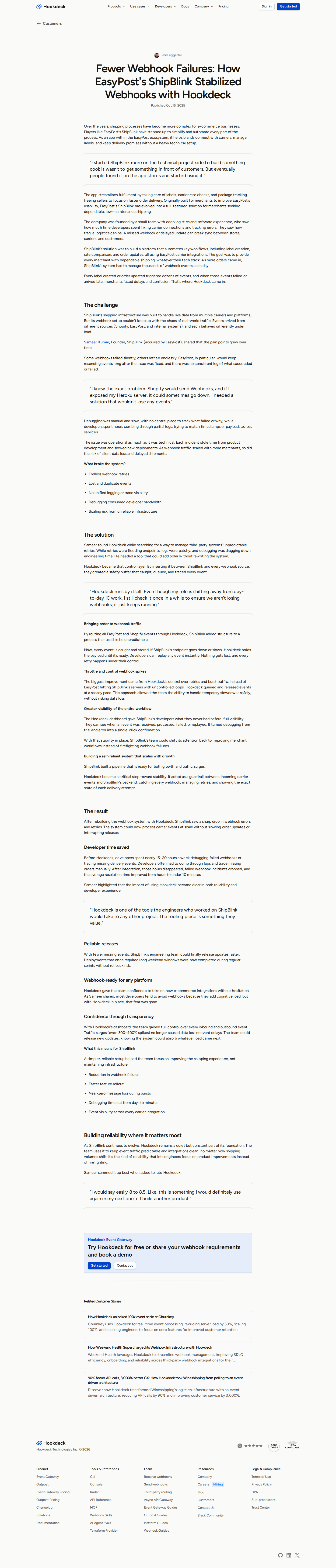 Click to enlarge ↗
 This is editorial commentary and curation. The case study, screenshot, and all metrics are Hookdeck's published work; we link to the source and lead with our analysis.