Stripe × Ticketera
Stripe x Ticketera, 100% uptime through a $32M high-stakes on-sale
100% uptime during 48-hour Bad Bunny on-sale processing $32M+
Operational risk and uncertainty to confident, incident-free execution
Members read free
Unlock the full breakdown
Enter your email to open every case study in the library: the full screenshot, why it works, and the one thing worth stealing. One email unlocks all of them.
Free. No spam. Unsubscribe anytime.
You're in — enjoy the library.
Why it works
The story is anchored by a concrete, high-stakes event that makes the resilience framing vivid: failure during a Bad Bunny on-sale would have been a public reputational disaster, so uptime and fraud prevention are genuinely the win, not just efficiency gains. The 64% reduction in fraudulent transactions gives the fraud-prevention thread its own measurable payoff, and the before/after on cost visibility adds a third layer without diluting the lead. The mechanism is specific enough to follow: a dedicated TAM, biweekly alignment calls, real-time Radar rule adjustments, and post-event review loops.
Steal this
Use a named, time-boxed event (a single 48-hour sale) as the proof crucible. It compresses the before/during/after arc into a single high-stakes moment, making resilience claims concrete and falsifiable rather than vague.
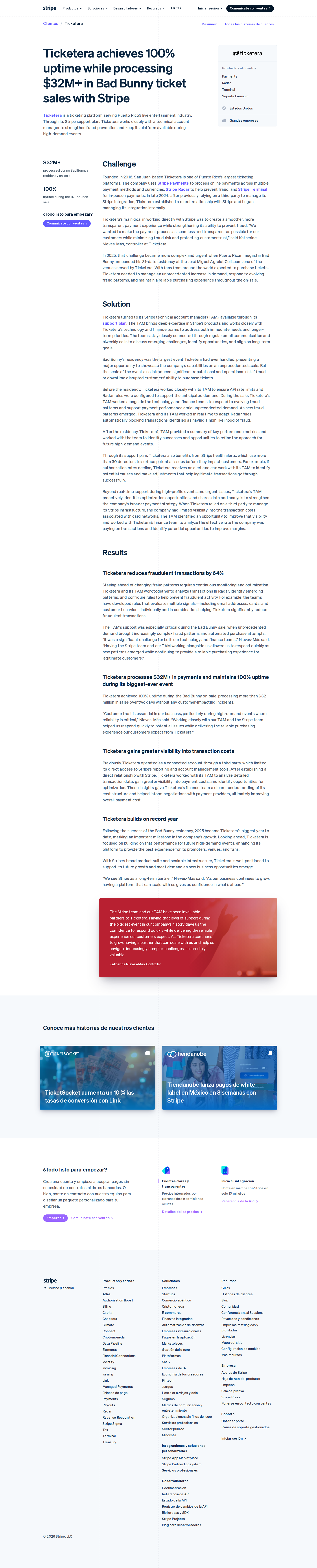 Click to enlarge ↗
 This is editorial commentary and curation. The case study, screenshot, and all metrics are Stripe's published work; we link to the source and lead with our analysis.