Temporal × Bugcrowd
Temporal x Bugcrowd, 400% capacity gain from legacy monolith escape
400% more capacity
Manual bottleneck to scalable ML-driven orchestration
Members read free
Unlock the full breakdown
Enter your email to open every case study in the library: the full screenshot, why it works, and the one thing worth stealing. One email unlocks all of them.
Free. No spam. Unsubscribe anytime.
You're in — enjoy the library.
Why it works
The case study pairs a concrete before-state (a manual, engineer-heavy hacker-matching process constrained by a Ruby monolith) with three specific outcome numbers, giving readers a clear sense of scale and direction. The mechanism is described in enough workflow-level detail that a technical reader can follow the architecture. The story leads with capacity growth, making Breakthrough the primary tag, but the efficiency gains (15 engineering hours saved per week, 50% downtime reduction) are strong enough to warrant a secondary tag.
Steal this
Describe the solution architecture at enough step-by-step detail (Orchestrator workflow, Hacker workflow, invitation child workflow, signals and timers) that the reader understands exactly how the result was produced, not just that it was.
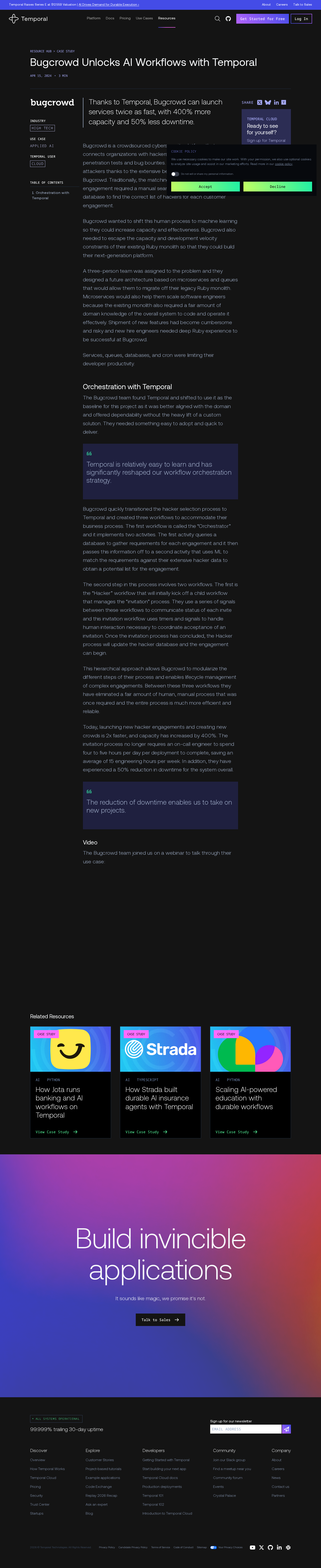 Click to enlarge ↗
 This is editorial commentary and curation. The case study, screenshot, and all metrics are Temporal's published work; we link to the source and lead with our analysis.