Docker × Tremendous
Docker x Tremendous: Closing the Supply Chain Gap with 90%+ CVE Reduction
90%+ CVE reduction across container images
Partial coverage and audit gaps to full supply-chain protection with verifiable evidence
Why it works
The case study earns its Resilience tag by grounding the before-state in a specific, real-world threat event (XZ Utils backdoor) rather than vague risk language. The two-layer framing (base image plus open-source dependencies) is concrete and gives the reader a mental model for why one tool was not enough. The per-image CVE reduction breakdowns add credibility without overclaiming, though the story is thin on business outcomes beyond security posture.
Steal this
Per-image CVE reduction tables (Ruby core ~95%, Node build ~97%, etc.) that disaggregate the headline stat into service-level proof, making the number hard to dismiss as a vendor-wide average.
Members read free
See the full case study
Enter your email to see the full-page screenshot of this case study, and every other one in the library. One email unlocks all of them.
Free. No spam. Unsubscribe anytime.
You're in. Enjoy the library.
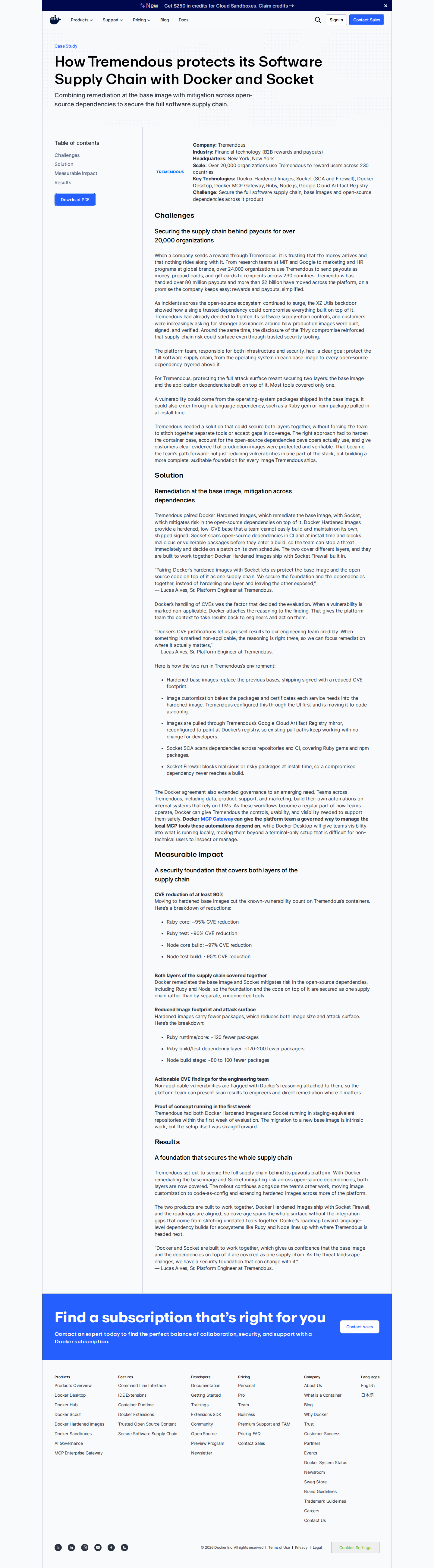 Click to enlarge ↗
This is editorial commentary and curation. The case study, screenshot, and all metrics are Docker's published work; we link to the source and lead with our analysis.