Notion × Clay
Notion x Clay: From knowledge store to self-running workflows
80+ active custom agents deployed in one week
Reactive and scattered to proactive and automated
Members read free
Unlock the full breakdown
Enter your email to open every case study in the library: the full screenshot, why it works, and the one thing worth stealing. One email unlocks all of them.
Free. No spam. Unsubscribe anytime.
You're in — enjoy the library.
Why it works
The story earns New Capability because Clay moved from a passive knowledge base to a system that routes and acts on information autonomously, something that was not practical before agents existed. The irony framing (a data-automation company bogged down by manual coordination) is a clean, credible hook that does not feel manufactured. Willie's quote about gaining information he would never have had otherwise sharpens the distinction between efficiency and net-new capability, though the story also has a strong Efficiency undercurrent.
Steal this
The irony hook: positioning the customer as a company that solves exactly the problem they were suffering from. It earns instant credibility and makes the pain feel authentic without exaggerating it.
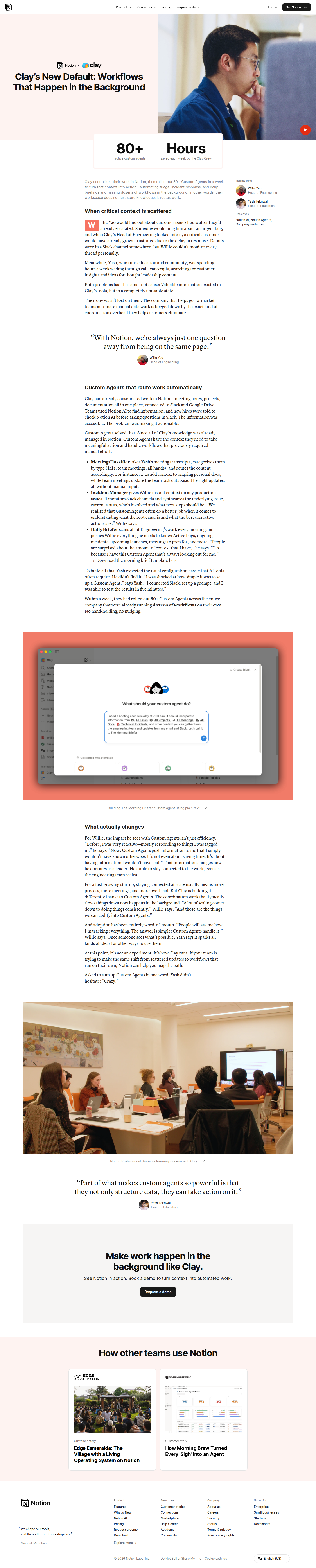 Click to enlarge ↗
 This is editorial commentary and curation. The case study, screenshot, and all metrics are Notion's published work; we link to the source and lead with our analysis.